I am not David
It’s said that you should never meet your heroes. But actually it’s the other way round: your heroes should never meet you. Witness the power of a bad idea, from Manchester Street Primary School in 1988 to meeting David Sedaris in 2025.
There was a note in my cubby hole which read “Richard sucks his bum”. It didn’t surprise me to be wronged at Lytton Street Primary, but I’d’ve expected the culprit to be Adam Wylder, who’d had it in for me from the day I transferred from Manchester Street Primary in 1988. Reason for enmity: unknown.
It was Adam who sharpened a pencil to a needlepoint and rammed it into the top of my head, making blood pool and congeal in my hair. It was probably Adam who filled one of my gumboots in the cloakroom with piss, but he must have had help, because filling an entire boot surely requires more than a single ten-year-old bladder can supply.
No one would come forward to bear witness that Adam had tried to execute me with a pencil and then pissed in a boot, so he was never brought to justice. Years later when I was a teenager, Dad pulled into the Feilding Shell station and it was Adam who filled our tank with petrol. I only needed a glimpse into those watery eyes set deep in his horsey face, to see the tightening of his mouth, to know that he remembered me. I glanced away as casually as I could feign and thought, I’m in a car and you’re working at a service station, mate. But really, I had nothing over Adam. He had a job, and money, which was more than what I had. Eventually I, too, would work at a Shell station pumping petrol, maybe as penance for thinking myself so superior.
The note in my cubby hole was not from Adam. School was finished for the day, and my best friend Melcahey and I were on cleaning duty, sweeping dust from the dark wood floors. I’d barely opened the note and Melcahey was leaning over my shoulder, ready to jump in on the joke.
On any other day in the schoolyard, I would have just laughed it off with Melcahey. “Richard sucks his bum” was no devastating insult. It was merely the best a ten-year-old boy unpracticed at ribbing could summon.
Melcahey probably thought it was a good idea.
I don’t why I overreacted. Perhaps I wanted to pin someone – anyone – down after Adam had evaded the authorities so many times. Or maybe it was because no one was around and so it didn’t feel like school, and school was where Melcahey and I were friends. Whatever the reason, I didn’t just shove Melcahey and laugh, but instead marched the note outside to our teacher Mr Arnold.
“Melcahey, come with me please,” Mr Arnold said.
Mr Arnold looked a lot like Tom Baker, the actor who played the fourth Doctor Who. He was forever drawing coloured chalk murals on the board for us to marvel at. After lunch during reading time, he would read us Anne Holm’s novel I am David with such heart I can still recall entire scenes in his voice. Now I could see wrinkles on Mr Arnold’s brow, and a clipped urgency to his step as he marched Melcahey across the concrete to the principal’s office. Now I was alone, sweeping a wooden floor which was now so shiny it barely needed the attention. In 1991 corporal punishment was no longer allowed in New Zealand schools, but some educators still practised. Only a year prior, our teacher Mrs Melton had taken Eddie Max across her lap and spanked him on the arse over and over, rapid fire.
Melcahey’s parents were called in, I heard later. From that day on, I was short a best friend. Melcahey wouldn’t even look me in the eye, let alone talk to me. Each of us had run with the first thing that popped into our ten-year-old heads, and paid the price. My family moved from Feilding to Whanganui in the middle of the night the following year, and I never saw Melcahey again.
Ideas can really bite you in the arse.
I had an idea recently.
My favourite writer David Sedaris was to grace New Zealand with an Auckland stop on his latest book tour. I decided that I’d go to his book signing and flip the script by giving him a signed copy of my own yet-to-be-published book.
A woman once went up to David at a signing and offered to remove the fatty tumour he’d complained about that evening. Federal law forbade him from keeping the tumour afterwards, and he really wanted to feed it to a deformed snapping turtle near his holiday home on Emerald Isle. David went with her across the state line, had the surgery, and wrote about it in Calypso:
“...I could feel slight tugs as she hacked at the tumour. It was like having my pocket picked by a trainee. My fatty pocket. The shreds were placed in a metal pan and resembled slivers of raw chicken breast.”
Anything could happen at a David Sedaris signing. I’d only hoped to siphon off a little of that magic.
Now I was in the book-signing line inside the Auckland Town Hall, and would soon be standing in front of David Sedaris. And only now was I running an honest assessment of this idea through my head.
This idea, it was dawning on me – it... wasn’t a good one.
Why did no one stop me? I thought.
My wife Vic had told me I should just go for it. A contractor I hired at work had said “That’s a very nice idea” and “I wish you all the best”. The local print shop clerk told me my tales were “lovely” and had written in an email “We look forward to helping you with your self-publishing journey”.
How cowardly a thought, to expect others to take on the dark labour of killing my dreams for me. I’d been whisked away so high on my own enthusiasm I hadn’t noticed any of the clues. The phrase “self-publishing”, for instance – practically an admission of failure.
My body knew something was off from the moment David emerged onstage 90 minutes earlier, in deep blue pantaloons and a sports jacket. My spine started to ache as one by one each supporting muscle tensed up. I squirmed back and forth in my seat. These wretched chairs, I thought to myself. Insufficiently ergonomic.
Then David started to read, and I broke into a sweat, suddenly very self-conscious even though I was one of hundreds in a dark, packed hall.
“Damn he’s good,” I whispered to Vic next to me.
The audience laughed at some line from David about opening a tin of sardines to feed a stray cat whilst shopping for clothes in Morocco. Or was it Egypt? Or was it tinned mackerel? Was this even a story about shopping for clothes and feeding strays, or had I conflated the two?
It fills me with anxiety to be grasping for such details as I write this. David seems able to document the past so vividly. He wrote about his methodology in Theft By Finding:
“Another old-fashioned practice I maintain is carrying a notebook, a small one I keep in my shirt pocket and never leave the house without. In it I register all the little things that strike me, not in great detail but just quickly. The following morning I’ll review what I jotted down and look for the most meaningful moment in the previous day, the one in which I felt truly present.”
I was somewhat relieved to read that in 2007 David told the New Orleans Times: “I exaggerate wildly, for the sake of the story. Mostly in dialogue.” In the sport of exaggeration, at least, perhaps I can keep up.
To be a little fair to myself: I’m not a complete nothing of a writer. I’ve had some work published here and there. But when David shuffled his stack of stories and set them to one side to begin “question time”, I realised I’d scarcely heard anything he’d read. I could think of little else but this: it was wilfully naive to think myself even remotely in this man’s orbit. I felt like I was about to offer a candle to the sun.
Several opening questions from the audience asked what David thought of Trump, no doubt hoping for the kind of witticisms Sedaris included in his 2008 essay Undecided, published in the lead-up to the US presidential election. Such as this:
“I think of being on an airplane. The flight attendant comes down the aisle with her food cart and, eventually, parks it beside my seat. ‘Can I interest you in the chicken?’ she asks. ‘Or would you prefer the platter of shit with bits of broken glass in it?’ To be undecided in this election is to pause for a moment and then ask how the chicken is cooked.”
This evening, David was coy about politics. He moved on from one woman’s question, only to have her shout out, cutting him off as he started to answer another:
“You’ve answered my question! We appreciate you.”
Please, I thought, as David ignored her and forged on.
A couple who looked to be in their fifties, a woman in a maroon dress and a man with a Sigmund Freud–beard, got up and left while Sedaris was still answering questions. I hadn’t considered that I could just up and leave and cut my losses. But if other people were doing it...
It was getting dark outside when Vic and I jostled through a slab of people in the foyer to look for the book-signing room. A curved staircase wound down from the upper level, and the lights glinted off the polished wooden balustrade. Each baluster was wrought into what looked like the shape of an internal organ. A kidney, maybe. I thought once more of David’s fatty tumour, and how I didn’t have anything remotely as interesting as impromptu back-alley surgery to offer him.
People were breaking off in every direction, and we lost our bearings for a moment.
“This way!” Vic said.
As we passed underneath an archway, TV presenter Jack Tame strode past in the opposite direction and our gazes met briefly. His steely blue eyes said, Don’t even look at me mate, I’m famous.
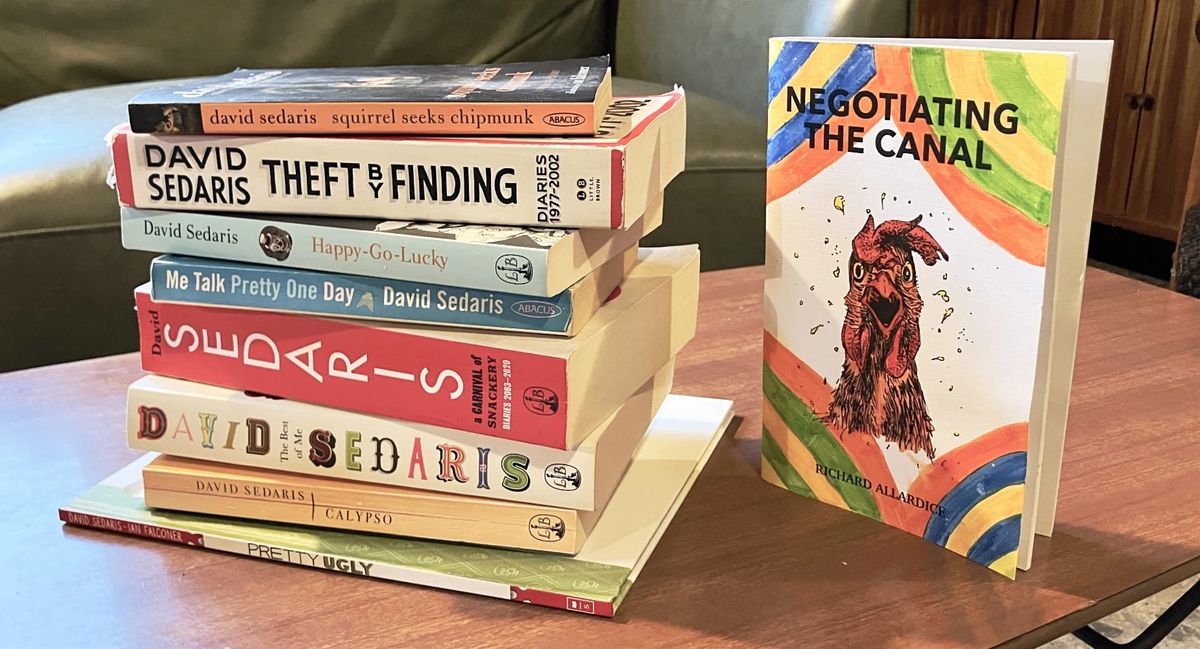
We walked past a pop-up bookshop selling David Sedaris books on our left. They had a kid’s book that was new to us, called Pretty Ugly. When we hit the signing line, I could see the Sigmund Freud–guy and his wife already talking to David, who was seated at a plain table with a collection of coloured markers.
“Ah. That’s why they left early,” I said to Vic. Not their first rodeo, it would seem.
“We’re gonna be here a while,” said Vic, looking at the line that wound back and forth 50 metres or so until it hit David. “I’m gonna get a copy of that new book, so we have one each to get signed.”
I looked around at my fellow queuers while Vic was gone. Most held shiny-covered books of the latest print edition purchased from the pop-up, flexing their spines for the first time. Many were reading from the first few pages, supposedly to legitimise themselves as David Sedaris readers at the eleventh hour. He’ll know, I thought. I ran my thumb across my creased, faded copy of Me Talk Pretty One Day, published 23 years prior. Though I was about to embarrass myself in front of my literary hero, it should at least be clear that I was a true fan.
Five metres ahead I spotted renowned New Zealand fashion designer Karen Walker, with (I’m assuming) her daughter. I was wearing tight wine-coloured pants and a slim-fit chocolate-brown shirt I’d found at a Whanganui op shop decades ago, around the same time I decided to try my hand at being a writer. Over my shoulder was a faded black tote bag with Django Girls Code written on the side, which I’d been given for free at my old workplace. I switched it to the opposite shoulder, out of the view of Karen Walker.
I pulled the book I planned to give to David out of the tote bag. The cover featured my own illustration of a chicken flicking margarine off itself in a feeding fervour. It made sense if you read my essay about how insane chickens go over margarine, but it had no connection to the book’s title, Negotiating the Canal, which was an essay about how useless I was at my daughter’s homebirth. The cheap card stock clung to my sweaty fingers. The print shop had stapled it together because I was in too much of a hurry for perfect binding, so it didn’t sit flat, but instead bulged at the spine, like the pages were poised to flutter away. It looked emphatically not literary. Like a pamphlet. Homemade. Something a stranger with no boundaries pushes into your hands as you step outside the train station.
“You miss 100% of the shots you don’t take,” a work friend is fond of repeating, a saying often attributed to Wayne Gretsky. I’ve always liked the powerful obstinacy of these words, but today, boy did it feel like I was going to miss. I was second-guessing everything now, but in all honesty really I’d done almost no first-guessing.
“I’m back!” Vic declared, appearing at my side with a crisp hardcover copy of Pretty Ugly. We read it standing alongside each other. At the end, the monster girl, despairing that she’s stuck looking like a human, but remembering that her family said “Real beauty is on the inside”, pulls herself inside out from the mouth, guts, brain and all, thus becoming a new kind of inverted flesh creature that she found quite fetching.
“That’s such a Sedaris punchline,” I laughed. It was also exactly how I felt. Inside out, innards squirming and oxidising. Exposed.
An assistant stopped by us in the line and gave us post-its to insert into our books.
“Write the name of whoever you want him to address it to,” she said, then walked off. In a podcast with Mike Birbiglia I’d heard David say that once he hands the signed book back, the encounter is over.
As we drew closer to the signing desk, the line was guided into a zigzag by ropes. A little ahead of us in the line, I spotted an old high school friend, Derrick, coming in the other direction.
“Hey Derrick,” I said. “Long time.”
“Oh...” he said dreamily. Behind his glasses his eyes slowly focused on my forehead “Timothy, was it? Um, thirty years, has it been since we’ve seen each other?”
It was actually 20 years, and not only had we shared years of classes together, but we went to the same design school in the early 2000s. Derrick was shorter than me at school, but he was now a couple of inches taller. He’d finally grown into those size 15 feet.
“It’s Richard,” I said. “We went to high school together.”
“Oh yes, was it? Hello there,” said Derrick, appearing to accept this as an inconsequential fact.
Derrick introduced me and Vic to his partner, Anya.
“This is the first time we’ve left our son at home, with a babysitter,” said Derrick.
They both kept checking their phones for any word from the sitter. The signing line was taking a long time, and Derrick explained it was pushing past the time they said they’d be home by.
“You’re dressed pretty fancy,” I observed, eyeing Derrick’s suit up and down.
“I just flew back in from a funeral earlier today,” said Derrick.
Because the line snaked back and forth, we would part ways with Derrick and Anya, only to reconnect with them for a while ten minutes later. When Derrick and Anya moved away for the last time and went on to talk to the man himself, I had to face reality: that soon we too would be talking to David.
I tried to tell myself: David is just some guy. Just smile and give him the damn pamphlet and go enjoy your evening. But some guy doesn’t go on Late Night with Seth Meyers. Some guy doesn’t command an international book tour.
The one who’s just some guy is me.
David handed the folks in front of us their book back, and it was our turn. Vic handed David a copy of Pretty Ugly with the names “Neko and Ida” on a sticky note.
“Who are these people?” David asked.
“They’re our children,” I stammered. “They travelled up with us. We listened to Dress Your Family in Corduroy and Denim on the way up, and it was a surprise hit!”
David paused and looked at me intently. Was he offended that I said it was a surprise that his book was a hit? I’d only meant that... for material not specifically written for children... it landed well with ours. I could feel sweat migrating across my ribs one at a time.
“They’ll probably argue over who gets this book,” Vic said, as David starting signing the inside page of Pretty Ugly. “Sometimes it’s as if they’ll fight about anything.” It has always dismayed Vic, as a person with one sibling she gets along well with, that our own kids bicker.
“But that’s just what siblings do,” David said, smiling.
I was so absent I didn’t even notice what he wrote inside the front cover:
“To Neko and Ida
ha ha
You’re children”
I handed David my tattered copy of Me Talk Pretty One Day, and he started to sketch a French flag inside the cover.
Vic and David started chatting about Lena Dunham’s memoir Not That Kind of Girl. David said that Dunham had received criticism for describing “putting a nickel in her sister’s vagina”. But kids were always putting nickels in each other’s vaginas, David said, so why would anyone be surprised to hear it straight? It was practically the job of a child to be weird and difficult with their siblings.
Even through the thick chowder of anxiety that had me in its grip – muffling my thoughts, slowing down time, and convincing me I might just die from shame – I was shocked awake by David’s repetition of the words nickel and vagina. I started calculating, wondering how I could possibly relate this later without sounding depraved, whether merely to possess such words on my computer could get me placed on an Interpol watchlist. These concerns would stay with me for a long time afterward. When I couldn’t verify the exact quote from Dunham’s book (it seems that they were pebbles, not nickels...), I worried whether I’d heard David correctly. I worried about people looking at my laptop screen while typing on the train. I worried about how I could ever meet David’s literary level, if I could not even match the level of his conversation. If I’d had any presence of mind in the moment, I might have asked “I’m sorry, but did you say... ‘nickel’?”
David handed Me Talk Pretty One Day back to me, which was the signal.
It was now or never.
Never had never felt so tempting.
“Um, actually, I have something for you,” I said. I could feel blood pounding behind my eyes. “Some stories I wrote. I signed it for you.”
David paused, and took my pamphlet. He turned it over to read the blurb but... I hadn’t added one. I did include mock testimonials: real quotes from my wife, my dad, and a colleague whose partner worked in publishing and told me I was unlikely to get anywhere unless it was a cookbook or I was already famous.
David read the first quote aloud. “You definitely shouldn’t give up just yet – Victoria Garlick.” He laughed.
He might have been laughing because he could tell that I definitely should give up. But I’ll take the laugh either way – the thinnest of silver linings.
Then, David put the pamphlet down and gave me a pursed smile. He folded his arms and sat back, which was clearly the final, final signal.
“Thank god that’s over,” I said to Vic, as we walked out of the town hall and into the sticky Auckland evening air.
“It was great. You did great,” Vic said.
Soon David would, I assume, toss my pamphlet into a greenroom waste paper bin – perhaps this was something he’d done many times – on his way back to his hotel to think about anything in the world except a silly collection of stories some punter expected him to read sight-unseen. But I didn’t feel bad straight away. Right then I felt ebullient, because: thank fuck it was over. Perhaps the true purpose of doing inordinately hard things is to experience the euphoria of being free from them, to experience the serenity of a life sans such terrible toil.
It’s said that you should never meet your heroes. Only now did I understand that it’s the other way round: your heroes should never meet you.
Now, finally, after making my big move and exactly nothing coming of it, I can relax into the moniker of failed writer. In the words of H. Jon Benjamin, titling his wonderful memoir: “Failure is an option”. As a failed writer I needn’t tense up when a visitor to my home asks “So what have you published?”, glancing towards the bookcase as if to see my best seller elevated on its own shelf. Nor need I get tetchy when the same well-meaning person goes on to tell me about a successful writer they know who isn’t me. As a failed writer I no longer need to worry about anything at all, because failure is the final chapter, and now the book is closed.
P.S.
In the accounting of these events, I am now unassailable by failure. Not because I have lived and breathed failure as an non-famous, book-less, unaffiliated writer for many years. (Although there is all that.) But because in presenting evidence of my failure I have either:
- Failed to deliver a good account and thus adequately demonstrated failure; or
- Succeeded in entertaining you with my account of failure
Either outcome could be considered a success.
P.P.S
How pompous, to include a postscript.


Comments ()